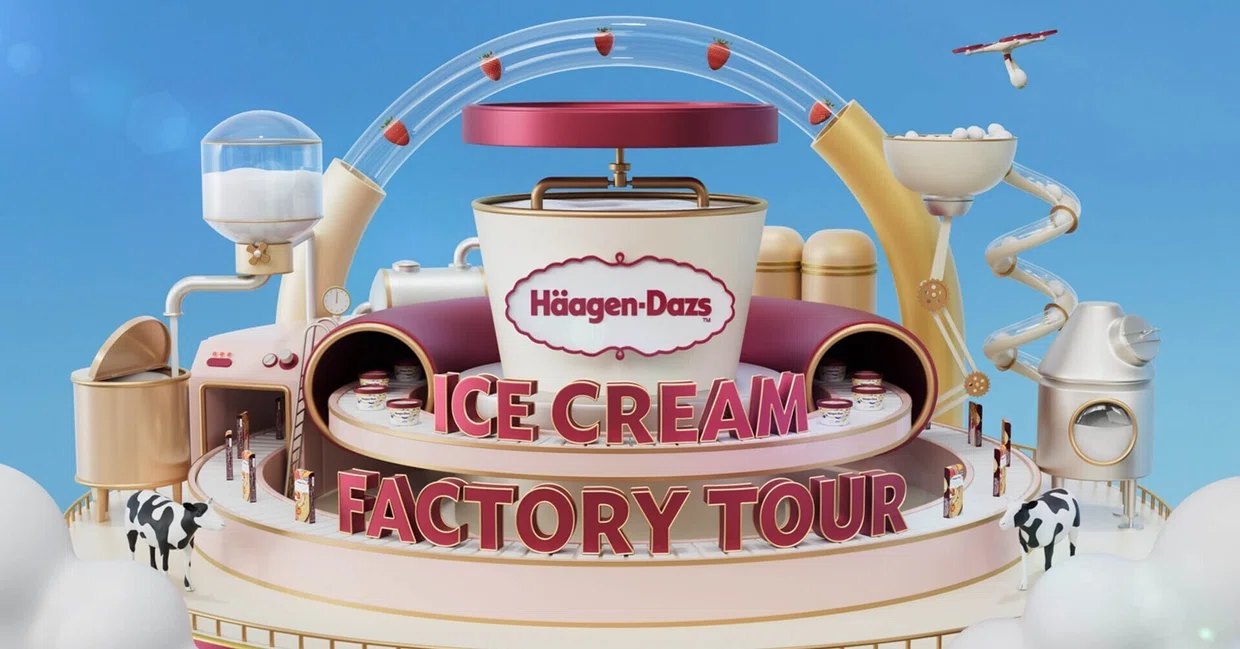
This is the story behind the website and films IN FOCUS created for the Häagen-Dazs Ice Cream Factory Tour. We brought the project team together for a roundtable conversation about how they combined 3D CG, motion graphics, and an interactive website to create an experience that children and adults could enjoy and learn from. Here, they share how the project took shape—and what went on behind the scenes.
Ice Cream Factory Tour website
https://www.haagen-dazs.co.jp/brand/special/hd-factory/
Starting with the Concept
- How did this project begin?
-
Sekiyama (Film Producer): Häagen-Dazs Japan approached us about creating a website and films to introduce their ice cream production process as part of the company’s 40th anniversary celebrations.
Häagen-Dazs has factories in just three countries around the world, and one of them is in Gunma, Japan. It isn’t open to the public, but apparently a lot of people had been asking to visit. The idea was to create a virtual tour that would introduce the factory and the care behind the products to a wider audience.Nakajima (Film Director): Simply explaining how a factory works, as if it were a lesson, wouldn’t be much fun. So we decided to use CG and animation to make it engaging. Here’s part of the proposal we brought to our first presentation. We suggested an immersive experience that felt more like an attraction. We also alternated between CG sequences showing the production process and illustrated explanations, creating a rhythm that would keep people interested.
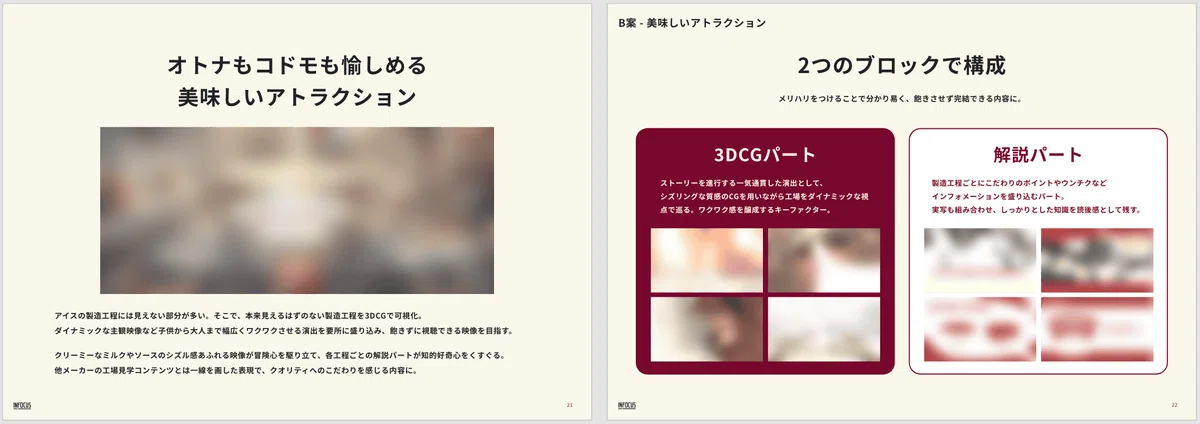
An excerpt from the project proposal Kaneishi (Creative Director / Web Director): The first direction we explored had a steampunk feel that emphasized the machinery of the factory. From there, we moved toward a cleaner, more premium look in keeping with the Häagen-Dazs brand colors. Even at the proposal stage, we prepared a range of layouts, storyboards, and visuals for both the website and the films so the client could picture the experience as clearly as possible.
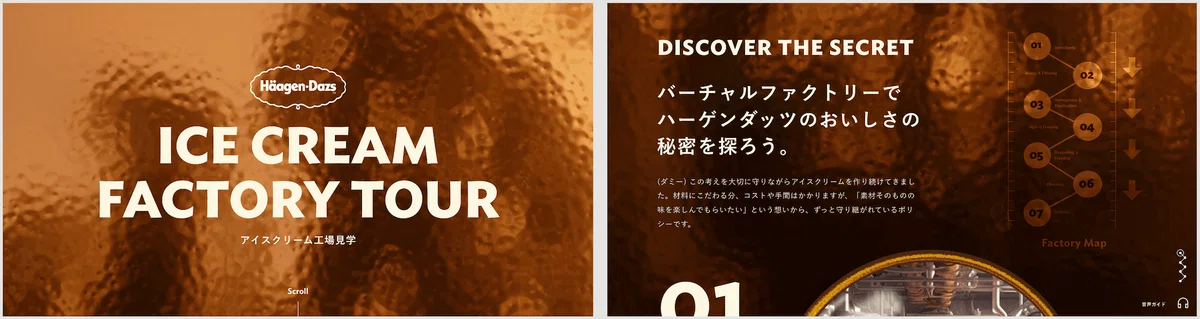
An early design emphasizing the machinery of the factory 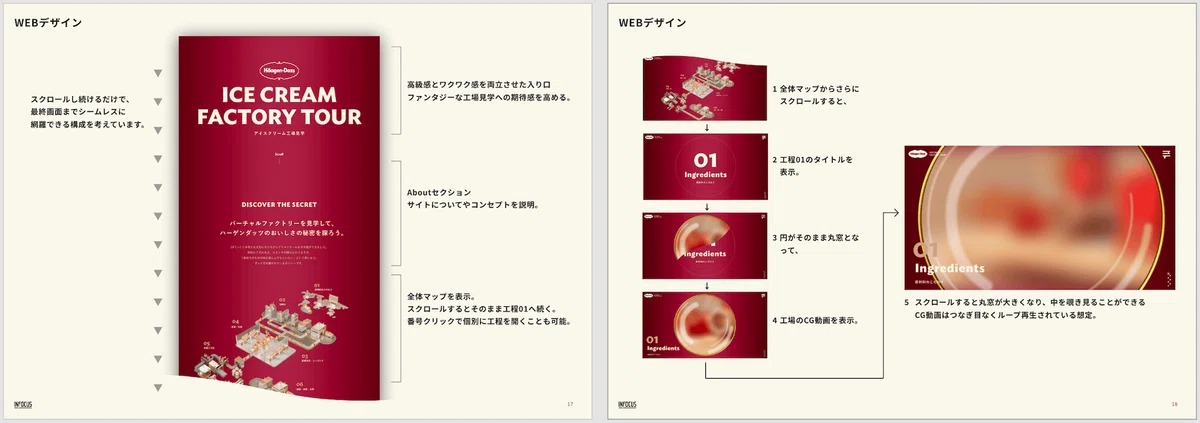
Refining the visual tone to suit Häagen-Dazs, alongside layouts and structural plans Nakajima: We even wrote all the narration at the planning stage. (Laughs.) The client was excited, too, and responded really positively. We had prepared another concept for the presentation, but they chose this one straight away.
Kaneishi: The web and film teams worked together from the very beginning, developing the concept and visual direction. That’s often how projects take shape at IN FOCUS, with its different creative disciplines. Being able to exchange specialist knowledge directly with the people doing the work is both fascinating and a great opportunity to learn.
From Hand-Drawn Sketches to a Fully Realized World
- Once the concept was approved, where did you begin production?
-
Kaneishi: We started with the main visual. It was crucial because the world we established there would set the standard for the entire project. Nakajima and I began by sketching out ideas by hand. At that point, though, we still couldn’t quite imagine how those drawings would look in 3D.
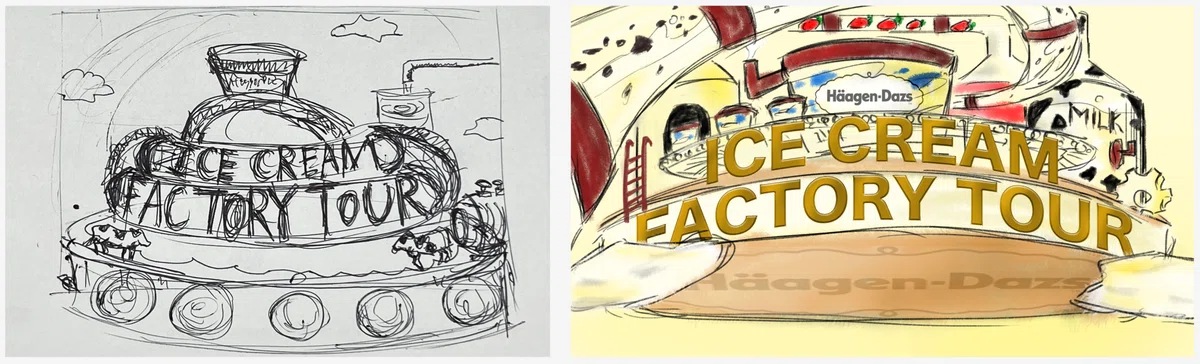
Initial hand-drawn sketches
- You can see the beginnings of the final design in the sketches, but there was clearly still a long way to go. How did you turn them into 3D CG?
-
Sekiyama: We asked KASSEN to handle the 3D CG production. They create outstanding CG and VFX, and I’d been hoping to work with them for some time. This felt like the right opportunity to reach out.
Kaneishi: We showed KASSEN our rough sketches, talked them through our ideas, and asked them to create an initial CG version. When it came back, I was amazed: “Those scrappy drawings have become three-dimensional!” But we wanted to bring out more of the premium feel associated with Häagen-Dazs, along with the excitement of a story about to begin. Working out how to get there was challenging.
Nakajima: Repeated rounds of CG revisions take a lot of time and work, so we needed to make our feedback as precise and focused as possible.
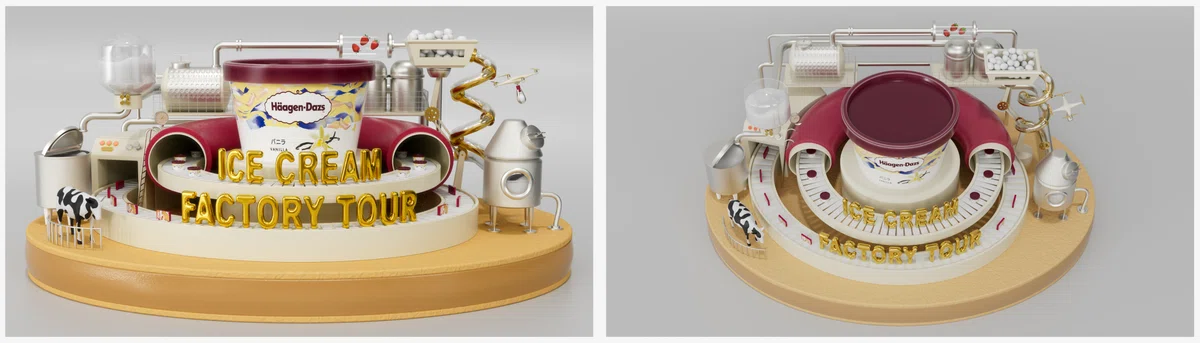
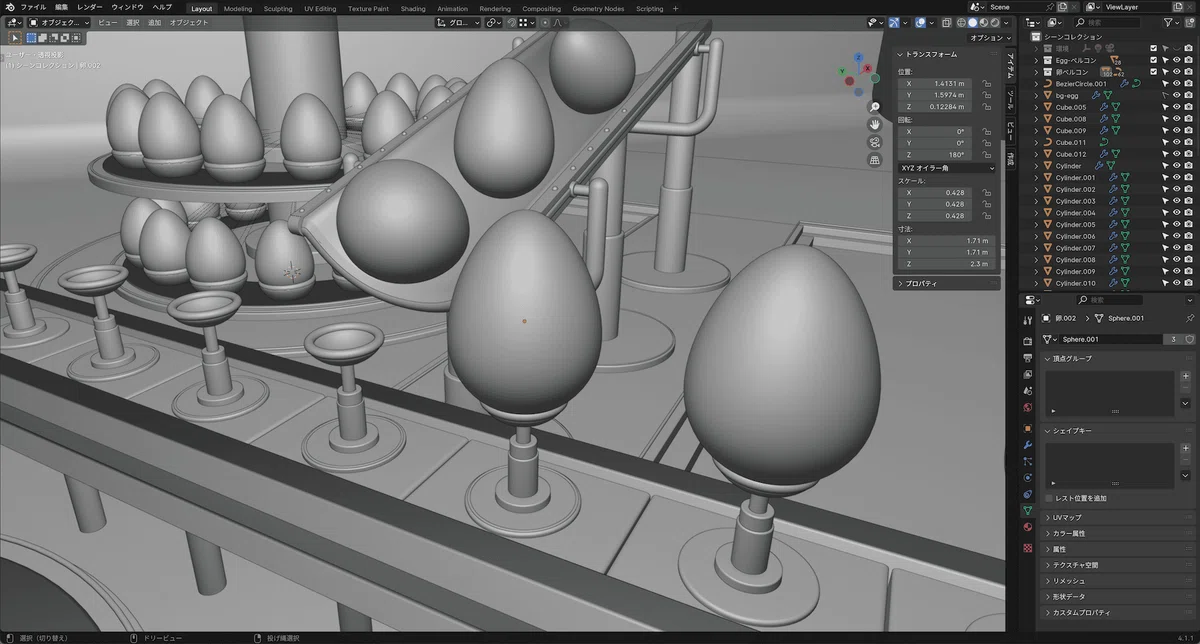
The first CG version of the main visual Kaneishi: It was just too difficult to work out the best adjustments through imagination and Photoshop alone. So I decided to roughly recreate KASSEN’s first version in Blender myself. That took some effort, but it meant I could experiment with the layout, colors, and textures until they felt right. We then turned those findings into feedback for KASSEN to apply to the final version.
Nakajima: Being able to try things ourselves also led to new ideas—like turning an ice cream lid into a mixing paddle. Once the design was settled, KASSEN animated it, completing the main visual and introductory film.
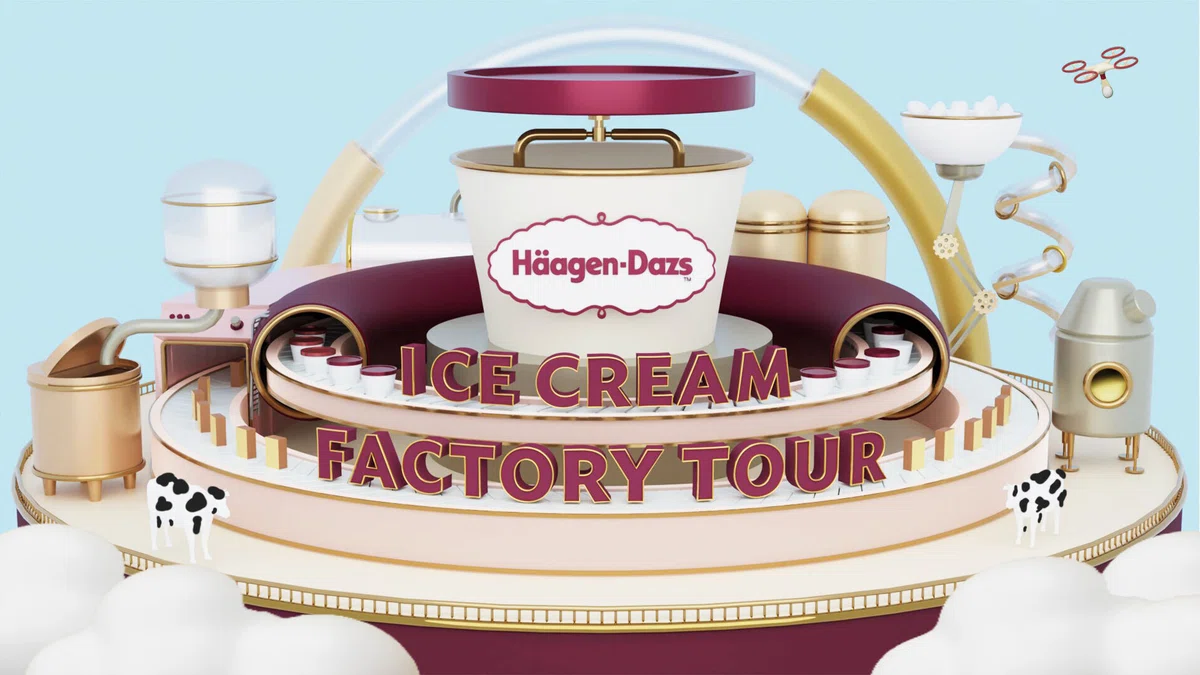
Recreating and refining the design in Blender 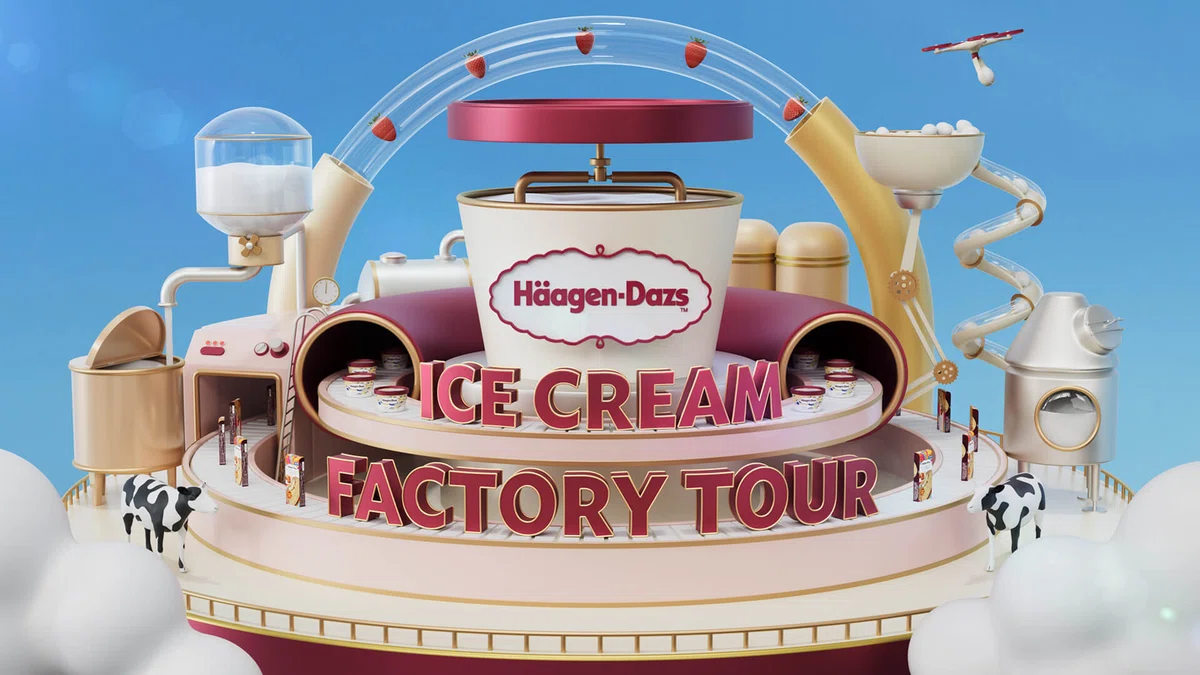
The completed main visual
Reimagining Ice Cream Production Through 3D CG
- The CG production sequences are so charming, and the movement is so engaging, that you could watch them for ages.
-
Nakajima: In a real factory, you often can’t see inside the machines. And many steps simply wouldn’t be visually interesting if we reproduced them exactly. So we decided to bring in a little fantasy and make the process fun to watch.
Kaneishi: For some steps, ideas came to us straight away. Others had all of us scratching our heads. At those moments, our designer Nagatsuka would find a reference that opened up a new direction and say, “How about something like this?”
Nagatsuka (Web Designer): I keep a big collection of reference images and videos. Something would come to mind during a conversation, and I’d say, “Oh, I’ve seen something that might work.” (Laughs.)
Kaneishi: The relevance of those references really helped us out.
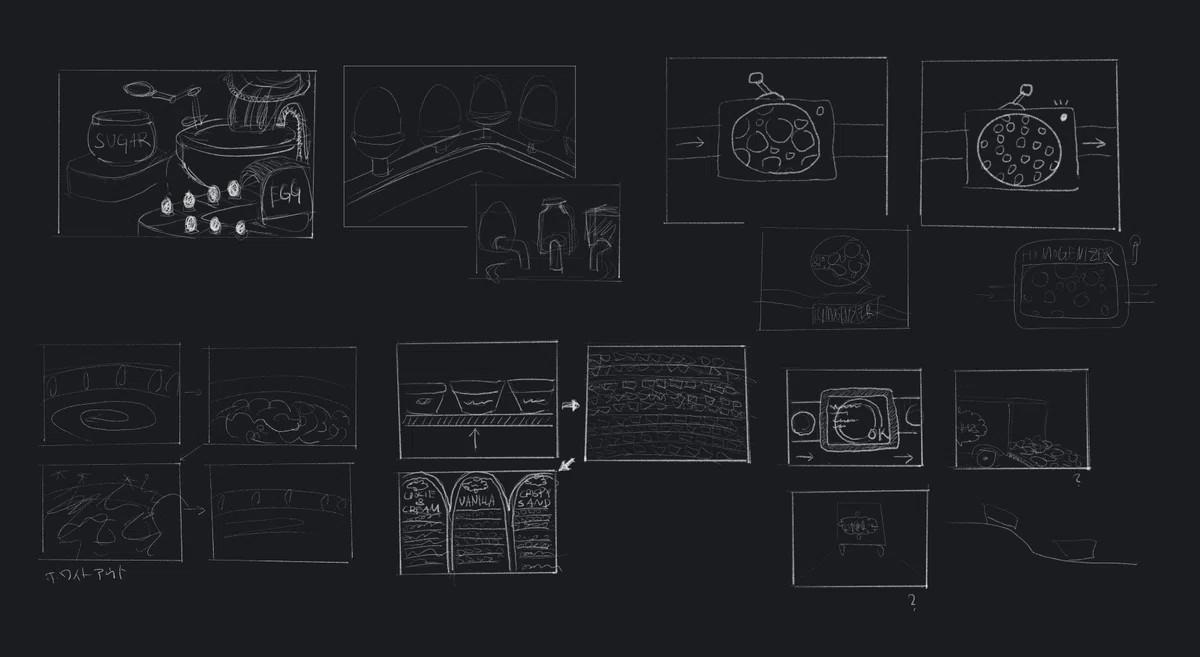
Concept sketches for the production sequences
- How did you develop those ideas into actual CG?
-
Kaneishi: After discussing the workflow with KASSEN, we decided that I would create the initial designs for the production sequences in Blender. I let my imagination run while trying to balance a premium feel with a sense of excitement. Designing all six stages was a lot of work, but adding details like an air duct here or a gold trim there was fun. Even if the machines were imaginary, they still had to communicate what was happening. I developed the designs with their movement in mind, too.
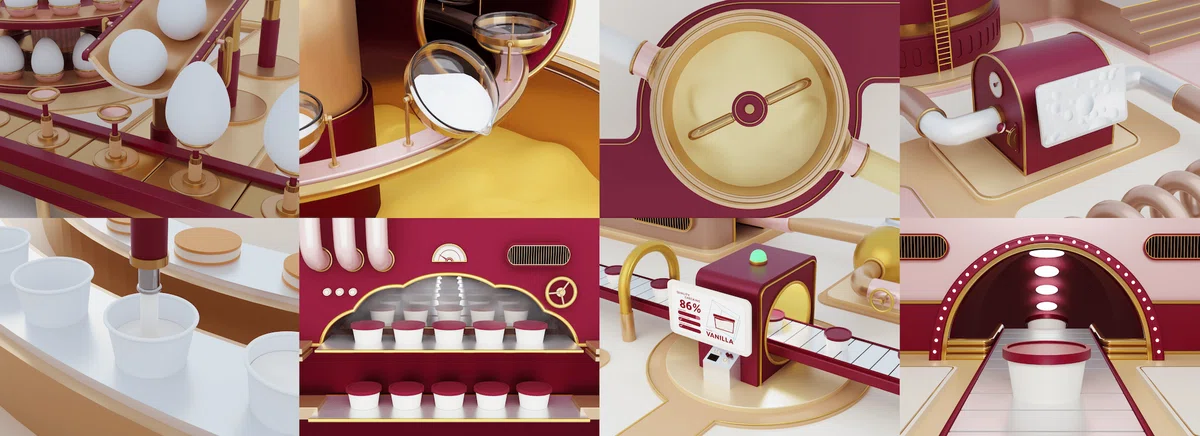
Rough CG designs, developed with camera angles and movement in mind Nakajima: Once the Blender designs were ready, we sent them to KASSEN for refinement and animation. They did a fantastic job with things like milk rushing through the machinery, the cooling sequences, and the texture of the cream being dispensed into cups, responding carefully to the client’s requests.
Kaneishi: There’s a shot of cream swirling through a pipe that we decided to add later on, so I took that one all the way through to the finished animation myself. This project certainly gave my Blender skills a workout. (Laughs.)
Nagatsuka: You also made the 3D floor map, didn’t you?
Kaneishi: At first, I thought we’d keep the floor map simple and use a still image. But Nagatsuka was very enthusiastic about making it more detailed—and ideally animating it, too—so I put in the work. (Laughs.) In the end, it was used in the films as well, so I’m glad we did it.
- You’re a web designer, Nagatsuka. Were you involved right from the 3D CG production stage?
-
Nagatsuka: Yes. Web design is usually my main focus, but on this project I joined repeated discussions with the film and graphic teams about the overall visual tone and design. Being able to experiment together across team boundaries was a really valuable experience.
- The films are fun to watch not just because of the CG, but also because the illustrated explanations are animated.
-
Nakajima: Even if the CG sequences were exciting, a dull explanation would immediately bring the energy down. So we used illustration and motion to keep things engaging and well-paced. To create contrast, we deliberately gave the illustrations a collage-like, handcrafted feel. The difference from the CG helps keep the experience fresh. Senzaki from the graphic team created the illustrations. We asked you to make quite a lot, didn’t we? (Laughs.)
Senzaki (Graphic Designer): Yes! It was difficult to find the right feel at first, so I made lots of versions. We were looking for a balance between the premium image of Häagen-Dazs and something that children and adults could easily understand and enjoy. As well as adjusting the number of colors and the textures, I explored tiny variations in things like patterns and which way the cows were facing. Seeing my designs come to life in the finished films was really moving!
Nakajima: Tanaka from the film team handled the motion graphics. The illustrations move with a lovely rhythm, and the scenes flow seamlessly into one another. It makes you want to watch the whole thing in one go.
Tanaka (Video Editor / Motion Graphic Designer): Whenever I’m working, I think about what kind of movement will feel satisfying and help the story flow naturally. Nakajima and I discussed the transitions between scenes a lot. I also really appreciated how Senzaki organized the artwork into detailed layers to make it easier to animate.
Filming at the Gunma Factory
- You actually went to the factory in Gunma to shoot the live-action sequences, right?
-
Nakajima: That’s right. Kataoka handled the shoot. The factory had never been shown to the public before, so he captured a lot of footage of places people don’t normally get to see.
Kataoka (Film Director): I wanted the live-action footage to feel natural alongside the fantasy world. We chose lenses that would give the images a crisp look in keeping with the main visual, and used a camera that could capture clean images even in dark areas. Then Nakajima and Tanaka did a great job bringing it all together so the live-action scenes didn’t feel out of place.
Nakajima: We didn’t want those sections to feel too raw or documentary-like, so we used slow motion and color adjustments to blend them into the overall world.
A Website That Lets You Peer into the Factory
- Tell us about creating the website.
-
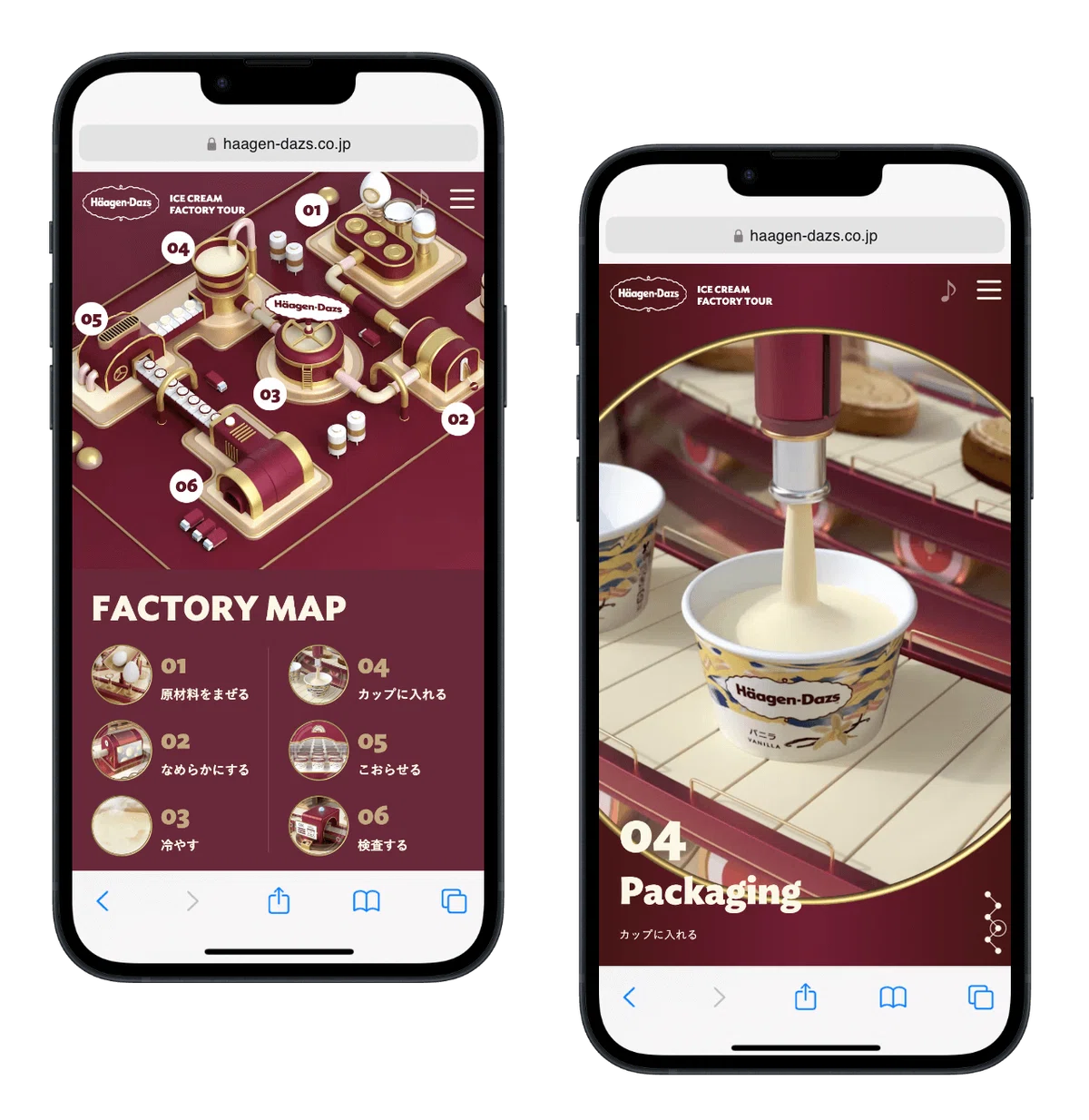
Kaneishi: The films were coming together so well that we knew the website had to match them. We wanted the online experience to feel like moving through a factory tour, and the circular windows became a key part of that. With CG like this, it’s tempting to show everything full-screen. Instead, we deliberately framed it as if you were peering inside. We wanted people to intuitively sense where they were in relation to the production floor, and imagine the larger spaces beyond the frame.
The experience also unfolds simply by scrolling, with the screen changing as you move through each stage. Because the CG is visually elaborate, we wanted the navigation itself to stay simple.Nagatsuka: We spent a lot of time getting the scrolling to feel right. A stage number appears, turns into a circular window, gradually expands, and then the explanatory section comes in over it. When you combine that many changes in one continuous movement, it’s easy for the screen to jump or feel awkward. Our engineer Abe patiently fine-tuned it until everything moved without a hitch.
- The scrolling really is smooth—it makes you want to keep exploring. What did you focus on during implementation?
-
Abe (Front-End Engineer): The overlapping elements were quite complex, so deciding how to structure everything took a lot of thought. It also had to work without bugs however someone navigated—scrolling back up midway through, jumping from the menu, or anything else.
Kaneishi: You even went back and rebuilt the structure to make the behavior more stable, didn’t you?
Abe: I rebuilt it about three times while experimenting with the underlying structure. (Laughs.) And because the site uses multiple videos, loading and playback control took quite a bit of work. We used a library called hls.js for streaming playback and developed the logic for controlling the audio. Personally, I was also happy to bring 3D into the website itself. The three cups that appear at the end were built with Three.js, and we made them tilt in response to the mouse.
Nagatsuka: With interactive websites, you often can’t really judge the experience until you’ve built it. Sometimes, as on this project, that means taking a bold step back and rethinking the foundations after a substantial amount of work is already done.
Kaneishi: Abe and the rest of the team keep their motivation right through to the end, which makes them incredibly dependable. When you don’t give up on those final details, the overall quality really does improve dramatically.
Bringing the Experience to Life Through Original Music and Sound
- We heard that the music was created especially for this project, too.
-
Nakajima: Yes. We commissioned original music for the energetic introduction, as well as machine sounds and ambient audio for each stage. We paid close attention to the sensory details to make the world feel immersive. We worked with composer Iwata and sound designer Yasue, both of whom we trust. Once the sound was added, the whole experience came alive.
Managing Production Across Teams
- What was it like to manage a project spanning film, graphic design, and web?
-
Ishizaki (Production Manager): As PM, I handled coordination and scheduling. I worked with a lot of people: our client, Häagen-Dazs Japan; KASSEN on the 3D production; and the film, web, and graphic teams at IN FOCUS. My previous job was at a film production company, so both the cross-disciplinary nature of the project and the extensive use of CG were new to me. It was a refreshing experience.
Nakajima: This was your first project after joining IN FOCUS, wasn’t it? Suddenly having to manage the schedules and budgets for web and graphics as well as film must have been a challenge. I feel like we had a meeting every other day. (Laughs.)
Ishizaki: That’s true. But I also got to see, up close, how the different departments worked together to make something great. It was a good introduction to IN FOCUS’s strengths right after joining.
The Response After Launch—and What the Client Had to Say
- A lot of work went into this project. What kind of response did it receive after launch?
-
Nakajima: I saw the Ice Cream Factory Tour covered by a lot of media outlets. There was a strong response on social media, too. Senzaki’s post on X received around 100,000 impressions, didn’t it?
Kaneishi: The website was also featured in Brain and Web Designing. It received Site of the Day at the CSS Design Awards and FWA of the Day at the FWA, and was nominated for Product Honors at Awwwards.
Sekiyama: Above all, it was great that the client was happy. This was our first time working with Häagen-Dazs Japan, so hearing them say, “We’re glad we chose IN FOCUS,” meant a lot.
Kaneishi: They told us they were really impressed with the finished work, and that the response internally had been excellent. They also said they were showing the website and films to media contacts, and using the factory footage in television programs and elsewhere.
Ishizaki: In the end, they told us they would make the factory tour one of the highlights of their 40th anniversary content. We were also happy to hear that the design of their pop-up store in August drew inspiration from the world of our production-process CG.
Kaneishi: I have two young daughters, and when I showed them the finished film, they watched it five times in a row, laughing and getting excited together. That’s when I felt we’d achieved the brief of making something children could enjoy and learn from. Of course, afterward they both asked for Häagen-Dazs! (Laughs.)
The Strength of Working Across Disciplines
- What did bringing different IN FOCUS teams together make possible on this project?
-
Ishizaki: Because everyone could see what was happening across the project in-house, it was easy to discuss adjustments to schedules and budgets quickly.
Senzaki: I’d only just joined the company, too, and working with the other departments helped me understand the whole production process.
Nakajima: It’s exciting to have experiences you wouldn’t get within your own department. Just seeing new knowledge and techniques in action is an education. I felt we worked more closely with one another’s teams than ever before.
Kaneishi: Because we’re all close to one another, we can share ideas openly and collaborate closely. Each person brings their own specialist skills, so we can try all kinds of things in-house as we go. I think that leads to stronger work, and it’s one of IN FOCUS’s real strengths.