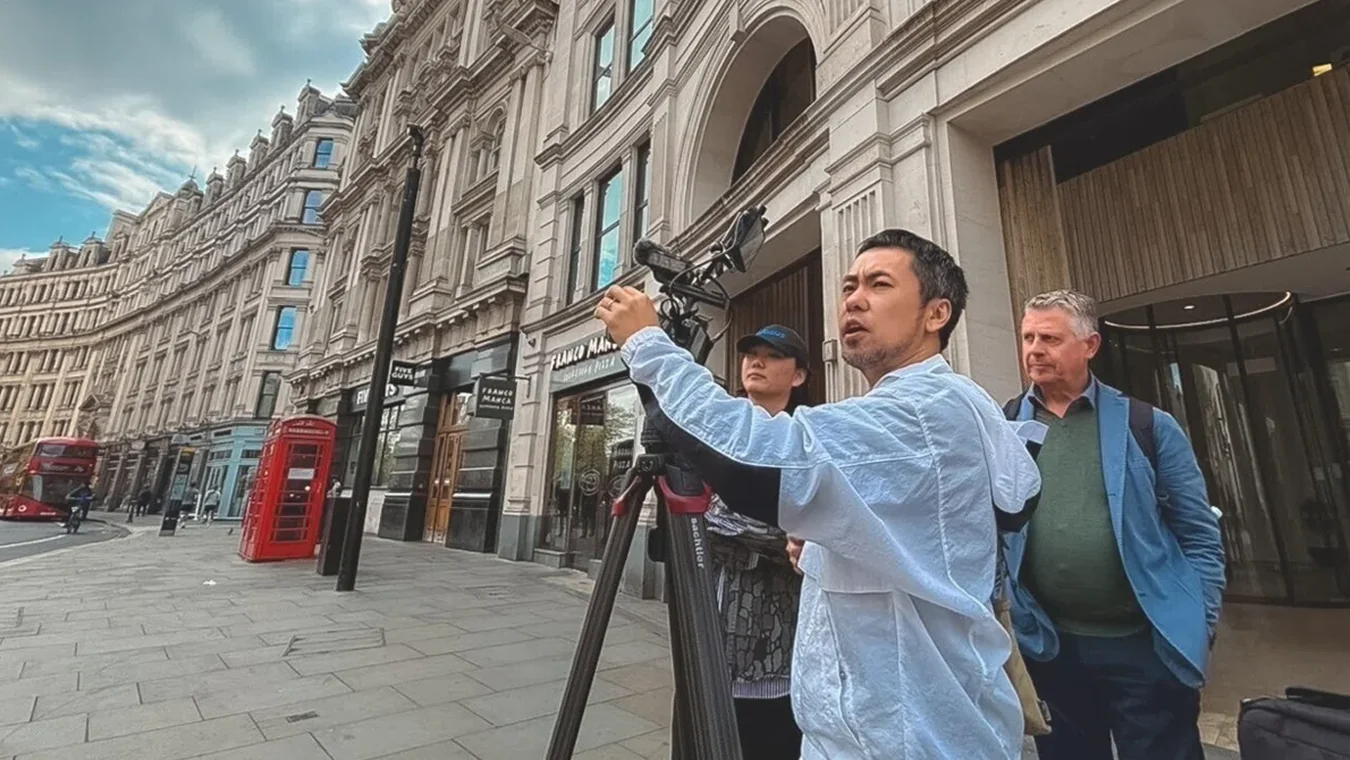
- To start, could you tell us what a video director does?
-
At its core, my job is to decide how a story is filmed, edited, and ultimately experienced by the audience. I’m responsible for shaping the way people feel when they watch a film.
Communication is also a huge part of the role. A film production involves many different people, and everyone naturally interprets a project differently.
One of my most important responsibilities is making sure the entire team shares the same vision so everyone can do their best work. In that sense, I often think of myself as the lubricant that keeps everything moving smoothly.
- What kinds of projects do you usually work on?
-
A lot of my work leans toward documentaries. Rather than shooting everything in a studio, I’m often traveling around Japan to capture stories where they happen.
I’ve also produced films related to art projects, such as exhibitions by artist Ichi Tashiro at CONTRAST and installations at Espace Louis Vuitton. I enjoy creating films with a strong sense of narrative.
Following the Journey of a Single Tree Becoming a Work of Art
- Which project has stayed with you the most? Could you give us an example of the documentaries you’ve made?
-
One recent project is “A Tree,” which launched earlier this year.
It’s a collaborative project between GINZA SIX and the architecture studio DAIKEI MILLS that documents, over the course of three years, the transformation of a single tree into both furniture and architecture.
The story takes place in Yoshino, Nara Prefecture. The documentary follows Keisuke Nakamura, founder of DAIKEI MILLS and the creative initiative SKWAT.With documentaries, it’s important to capture people’s attention immediately, so I wanted the opening shot to be especially striking. We began with a scene deep in the forest, showing a craftsman looking up at a single towering tree. That image became a symbolic visual representing the heart of the project.
Our cinematographer was Ivan Kovac, who is originally from Australia. Perhaps because he views Japan from an outsider’s perspective, he’s incredibly skilled at capturing the country’s unique landscapes.
I think we were able to create a film that honestly documents reality while maintaining a quiet sense of reverence.Since this is a three-year project, I’m excited to continue documenting its journey.
Exploring Independent Cinemas Across Japan and Discovering Their Stories
- What other projects stand out to you?
-
One is “MINI THEATER JOURNEY.”
We traveled across Japan producing a series of ten documentaries about independent movie theaters.Unlike large multiplexes, these small, independently operated cinemas have been steadily disappearing over the years. Yet they play an important role—not only in preserving film culture, but also in supporting the local communities around them. That was the central message we wanted to communicate.
As someone who makes films and loves cinema, I felt this was a project that truly deserved to be made.
- When developing the concept, what were you most focused on?
-
I knew the audience would probably be people who already love movies. So I wanted to emphasize something that’s at the heart of cinema itself: emotional resonance.
Rather than simply presenting facts, we focused on how the people running these theaters feel about cinema and what these places mean to them.
By exploring those emotions in depth, I hoped viewers would naturally connect with the stories instead of feeling like they were being told what to think.
- After watching the series, I felt every theater had its own unique history.
-
Exactly. Every independent theater has a completely different background, history, and owner. But they all shared one thing: a genuine love not only for movies, but for people.
Film had become a way for them to build connections with others. These theaters aren’t just places to watch movies—they’re gathering spaces where communities come together.
I think the documentaries capture those unique local cultures and values.
Bringing a Bronze Statue to Life Through Emotional Storytelling
- Even documentaries can feel highly narrative through editing and structure. What about projects based more on fiction?
-
One example is the Waseda Sports BEYOND 125 Project.
It celebrated the 125th anniversary of Waseda University’s athletic programs and was part of a broader effort to rebrand Waseda Sports. I was involved from the initial concept stage.During a brainstorming session, someone jokingly said, “Wouldn’t it be funny if Shigenobu Okuma suddenly came to life?”
Surprisingly, everyone loved the idea. Eventually it evolved into a story where Okuma is revived in the present day and joins the athletes.
- That’s a fun concept. What did you focus on visually?
-
The story follows Okuma returning to modern-day Waseda, making an incredible athletic play, and inspiring today’s students as they watch him.
The challenge was making sure it didn’t become comedic. We worked hard to create a sense of realism, finding the right balance so it felt believable without becoming overly explanatory or overly fantastical.The music was also specially composed using melodies from Waseda University’s famous fight song, “Konpeki no Sora.” I think that made it especially meaningful for members of the university community.
One fun behind-the-scenes story is that the actor we cast as Okuma happened to be a Waseda alumnus himself. He carefully studied Okuma’s mannerisms and brought a genuine affection for the university to the role.
The sports scenes featured actual student athletes from Waseda’s track, baseball, volleyball, soccer, and other teams, all wearing special makeup. Because so many people from the university participated, I think the finished film truly reflects the spirit of Waseda Sports.
Creating worlds that reveal what’s real and essential.
- Is there a common philosophy behind the films you create?
-
The most important thing for me is how a story is constructed.
No matter how strong the subject or footage is, the structure completely changes how audiences experience it.
Personally, I love the pacing of American films. They move quickly while still delivering genuine emotional impact. That’s the kind of storytelling I always strive for.
At the end of the day, I believe film should entertain first. It shouldn’t feel like homework or a lecture.
- What makes filmmaking so exciting for you?
-
Even documentaries aren’t simply about recording reality.
To communicate what’s truly important—the atmosphere, the emotion, the deeper truth—you have to carefully decide what to show, what to leave out, and in what order to present it.
That’s why I see documentary filmmaking as an act of world-building.
Through editing, composition, and direction, you can reveal emotions and truths that wouldn’t be fully understood if you simply showed events exactly as they happened.
Watching dozens of people come together, all committed to communicating something honestly and powerfully, and creating a film that genuinely moves people—that’s the part of filmmaking that excites me most.
How Moving to the U.S. at 18 Sparked a Lifelong Passion for Film
- We’d also love to hear about your own journey. You moved to San Francisco after graduating high school. How did that happen?
-
I’d loved movies since I was in middle school and knew I wanted to work in the film industry. I figured that if I wanted to study filmmaking, the U.S. was the place to do it. But I had no idea how to make that happen, so on my second day of high school I went straight to the guidance office and asked how I could study abroad.
They introduced me to a university in San Francisco with a film program, and from then on I spent my high school years focusing almost entirely on studying English.
- What was studying film like?
-
The program was fairly classroom-based, but it gave me a solid foundation in the fundamentals of filmmaking and visual storytelling.
Eventually I realized that continuing into the directing track would require another two or three years of study. Instead, I chose to gain practical experience through an internship, which led me to a production company in Los Angeles where I worked on music videos and commercials.
- How did you end up joining INFOCUS?
-
I met INFOCUS founder Iguchi while I was living in San Francisco.
When INFOCUS began expanding into video production, he invited me to join. Even after I returned to Japan, he continued offering me video projects, and eventually I felt it was the right opportunity to become part of the team.
I was actually the third member to join IN FOCUS.
- So that connection in San Francisco shaped where you are today. As one of the earliest members, how do you see the video team now?
-
The team has grown significantly, and so has what we’re capable of creating.
I honestly feel like we’re constantly building an even stronger team. Every time someone new joins, I’m genuinely excited because it opens up even more possibilities.
- Finally, as a lifelong movie lover, what’s one film everyone should watch?
-
Back to the Future.
No matter how many times I watch it, it’s still incredible. It’s a true classic—and I think everyone should see it at least once.